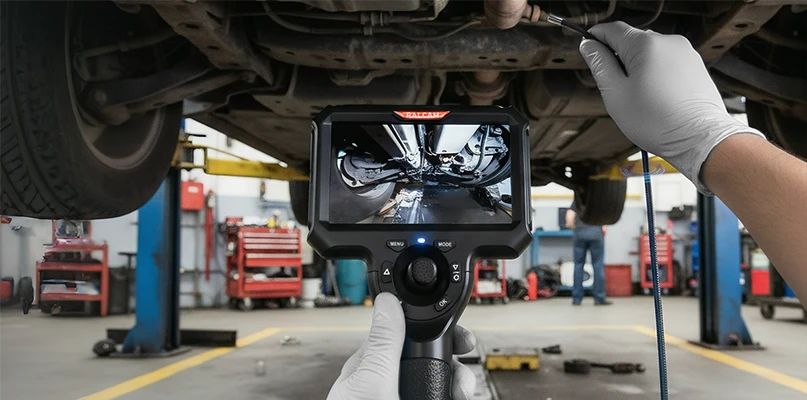
Plumbing Borescopes — Drain, Pipe & Sewer Endoscope Cameras
See inside the line before anyone digs. Ralcam plumbing borescopes feed an IP67-rated probe into drains, waste lines, and duct runs — locating the blockage, the root intrusion, or the hairline crack while the excavator is still on the trailer.


Original price
$648.99
Original price
$648.99
-
Original price
$648.99
Original price
$648.99
Current price
$599.99
$599.99
-
$599.99
Current price
$599.99
Ralcam M506 Modular Borescope – Interchangeable Probes, 5" HD
Ralcam
In stock
The Modular Inspection Camera Built for Professionals Stop carrying multiple scopes for different jobs. The M506 Modular Borescope System centraliz...
View full details
Original price
$648.99
Original price
$648.99
-
Original price
$648.99
Original price
$648.99
Current price
$599.99
$599.99
-
$599.99
Current price
$599.99
Save 8%


Original price
$227.99
-
Original price
$251.99
Original price
$227.99
-
Original price
$251.99
Original price
$227.99
$168.00
-
$184.00
$168.00
-
$184.00
Current price
$168.00
Automotive Inspection Camera – Ralcam H406B | 4.3" Borescope
Ralcam
In stock
Something in there needs looking at, and you can't get your eyes to it — a rattle behind the dash, a drain that won't clear, a wall you'd rather no...
View full details
Original price
$227.99
-
Original price
$251.99
Original price
$227.99
-
Original price
$251.99
Original price
$227.99
$168.00
-
$184.00
$168.00
-
$184.00
Current price
$168.00
Save up to 27%

Original price
$499.99
-
Original price
$539.99
Original price
$499.99
-
Original price
$539.99
Original price
$499.99
$452.00
-
$488.00
$452.00
-
$488.00
Current price
$452.00
4-Way Articulating Endoscope – Ralcam M6X | 5" IPS Screen
Ralcam
Out of stock
Ralcam M6X — Professional 4-Way Articulating Borescope with 5" IPS Screen The M6X is built for inspections where a 2-way scope runs out of reach. A...
View full details
Original price
$499.99
-
Original price
$539.99
Original price
$499.99
-
Original price
$539.99
Original price
$499.99
$452.00
-
$488.00
$452.00
-
$488.00
Current price
$452.00
Sold out


Original price
$299.99
-
Original price
$312.00
Original price
$299.99
-
Original price
$312.00
Original price
$299.99
$149.99
-
$181.00
$149.99
-
$181.00
Current price
$149.99
Portable Articulating Borescope – Ralcam F408B
Ralcam
In stock
Ralcam F408B — Portable Articulating Borescope with 4.5" Screen The F408B is a stand-alone articulating borescope with a large 4.5" IPS display — b...
View full details
Original price
$299.99
-
Original price
$312.00
Original price
$299.99
-
Original price
$312.00
Original price
$299.99
$149.99
-
$181.00
$149.99
-
$181.00
Current price
$149.99
Save up to 50%


Original price
$131.99
-
Original price
$199.99
Original price
$131.99
-
Original price
$199.99
Original price
$167.99
$131.99
-
$174.00
$131.99
-
$174.00
Current price
$131.99
Car Inspection Camera – Ralcam N308S | 8.5mm Engine Inspection
Ralcam
In stock
Ralcam N308S — Car Inspection Camera with 8.5 mm Probe At 1600×1200 the N308S resolves finer detail than most inspection cameras in its class — eno...
View full details
Original price
$131.99
-
Original price
$199.99
Original price
$131.99
-
Original price
$199.99
Original price
$167.99
$131.99
-
$174.00
$131.99
-
$174.00
Current price
$131.99
Save up to 21%
Drain, Pipe, and Duct Inspection
Guessing where a blockage sits is expensive twice over: once for the excavation that finds nothing, and again for the customer relationship. A plumbing endoscope answers the question in minutes and leaves you with footage to show the person paying for the work. That second part matters more than most people expect — a thirty-second clip of root intrusion at a joint ends the conversation about whether the repair was necessary.
Plumbing Borescope or Push-Rod Sewer Camera? Read This First
These are two different tools and the search term plumbing camera gets used for both. Picking the wrong one wastes either money or a trip back to the van, so here is the honest split:
| Ralcam plumbing borescope | Push-rod sewer camera | |
|---|---|---|
| Working length | 1 m, 2 m, 3 m standard; longer made to order | 20–60 m |
| Head diameter | 3.9 / 5.5 / 6.2 / 8.5 mm | Typically 25–50 mm |
| Steering | 2-way or 4-way articulating tip | Usually a fixed head |
| Built for | Traps, P-bends, sink and tub drains, appliance lines, wall cavities, HVAC duct, pre-dig verification | Main sewer laterals and long buried runs |
| Locating | Visual only | Often paired with a sonde and locator |
| Cost bracket | Toolbox money | Several thousand |
So: if your job is a 15-metre buried lateral, buy a push-rod sewer camera — that is not what this collection is. If your work is inside the building — under sinks, behind walls, through traps and appliance lines, into duct runs, or confirming a diagnosis before you commit to breaking concrete — an articulating borescope does it faster, fits where a sewer head cannot, and costs a fraction as much.
Probe Diameter vs. Pipe Size
The head has to clear the bend, not just the bore. A useful rule is to leave roughly three times the head diameter of clearance so the tip can still articulate once it is inside.
| Probe | Comfortable in | Notes |
|---|---|---|
| 3.9 mm | Appliance lines, condensate drains, tight conduit | Smallest head; least light output |
| 5.5 mm | Sink traps, 32–40 mm waste | Good all-round balance |
| 6.2 mm | 40–50 mm waste, tub and shower drains | The most common choice for plumbing work |
| 8.5 mm | 75–110 mm stacks, duct runs | Brightest LEDs — what you want in a dark, wet line |
In practice most plumbers settle on 6.2 mm and keep an 8.5 mm head for stack and duct work. If you would rather not own two tools, the M506 modular borescope takes interchangeable probes on one handset, so the head changes with the job instead of the tool.
Cable Type: Semi-Rigid Is What Makes Pipe Work Practical
Cable choice matters more in plumbing than in any other inspection job. A fully flexible cable coils up the moment it meets resistance and will not feed itself past a bend. A fully rigid one cannot turn a trap at all.
Semi-rigid is the middle ground and the reason pipe work is possible at all: enough column strength to push itself along a run, enough memory to hold the shape of a bend once you have negotiated it. Ralcam semi-rigid cables come in 1 m, 2 m, and 3 m. Runs beyond that are made to order — worth knowing that custom lengths ship as non-returnable, so measure the job before you specify.
What a Plumbing Endoscope Finds
Grease and scale buildup narrowing the bore. Root intrusion at joints and couplings — the single most common cause of recurring blockages in older properties. Collapsed and offset sections where ground has shifted. Foreign objects, which in domestic work is usually something that went down a toilet. Corrosion pitting in metal lines. And standing water where a fall has been laid wrong, which looks like nothing on the surface and explains everything about why the line keeps backing up.
In HVAC work the same tool covers duct debris, disconnected or crushed flexible runs, and fouled evaporator coils that cannot be reached any other way.
Reading the Screen in a Wet Line
Two things make drain footage hard to read, and both have fixes. Water on the lens scatters the LED light and washes out the image — pull back, let it drain or shake clear, and go again rather than pushing harder. Reflective wet walls bounce light straight back at the sensor; dropping LED brightness usually gives you more usable detail in a wet pipe, not less, which is the opposite of what instinct suggests.
Worth being precise about one specification: the IP67 rating covers the probe and cable, which is the part that goes in the water. The handset and screen are not submersible. That is the norm for this class of tool, but it is the kind of detail that ends up in a warranty conversation, so it is stated here plainly.
Recording the Job
Recording to a TF card is standard across models with a built-in screen, which is what turns an inspection into a document — a before-and-after pair on the job file settles disputes and supports the invoice. For wall cavities and crawlspaces alongside pipe work, see home inspection cameras; for the full range across every probe size and articulation type, see all borescopes.