Automotive Borescopes — Engine & Vehicle Inspection Cameras | Ralcam
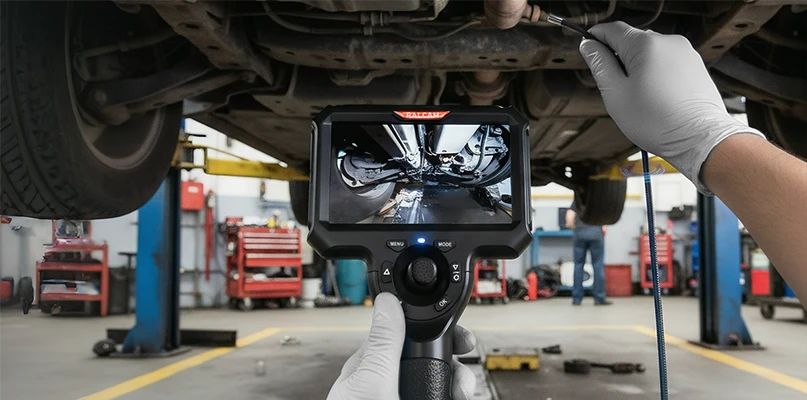
Find engine problems before you take anything apart. A Ralcam automotive borescope goes in through the spark plug hole, intake port, or valve cover and puts the cylinder wall, piston crown, and valve seats on a live HD feed.


Original price
$299.99
-
Original price
$449.99
Original price
$299.99
-
Original price
$449.99
Original price
$299.99
$279.99
-
$429.99
$279.99
-
$429.99
Current price
$279.99
4-Way Articulating Borescope – Ralcam F606B
Ralcam
In stock
Ralcam F606B — 4-Way Articulating Borescope with 4.3" Screen The F606B steers its camera tip independently up, down, left and right, so you can rou...
View full details
Original price
$299.99
-
Original price
$449.99
Original price
$299.99
-
Original price
$449.99
Original price
$299.99
$279.99
-
$429.99
$279.99
-
$429.99
Current price
$279.99
Save up to 7%


Original price
$648.99
Original price
$648.99
-
Original price
$648.99
Original price
$648.99
Current price
$599.99
$599.99
-
$599.99
Current price
$599.99
Ralcam M506 Modular Borescope – Interchangeable Probes, 5" HD
Ralcam
In stock
The Modular Inspection Camera Built for Professionals Stop carrying multiple scopes for different jobs. The M506 Modular Borescope System centraliz...
View full details
Original price
$648.99
Original price
$648.99
-
Original price
$648.99
Original price
$648.99
Current price
$599.99
$599.99
-
$599.99
Current price
$599.99
Save 8%


Original price
$227.99
-
Original price
$251.99
Original price
$227.99
-
Original price
$251.99
Original price
$227.99
$168.00
-
$184.00
$168.00
-
$184.00
Current price
$168.00
Automotive Inspection Camera – Ralcam H406B | 4.3" Borescope
Ralcam
In stock
Something in there needs looking at, and you can't get your eyes to it — a rattle behind the dash, a drain that won't clear, a wall you'd rather no...
View full details
Original price
$227.99
-
Original price
$251.99
Original price
$227.99
-
Original price
$251.99
Original price
$227.99
$168.00
-
$184.00
$168.00
-
$184.00
Current price
$168.00
Save up to 27%


Original price
$299.99
-
Original price
$312.00
Original price
$299.99
-
Original price
$312.00
Original price
$299.99
$149.99
-
$181.00
$149.99
-
$181.00
Current price
$149.99
Portable Articulating Borescope – Ralcam F408B
Ralcam
In stock
Ralcam F408B — Portable Articulating Borescope with 4.5" Screen The F408B is a stand-alone articulating borescope with a large 4.5" IPS display — b...
View full details
Original price
$299.99
-
Original price
$312.00
Original price
$299.99
-
Original price
$312.00
Original price
$299.99
$149.99
-
$181.00
$149.99
-
$181.00
Current price
$149.99
Save up to 50%

Original price
$499.99
-
Original price
$539.99
Original price
$499.99
-
Original price
$539.99
Original price
$499.99
$452.00
-
$488.00
$452.00
-
$488.00
Current price
$452.00
4-Way Articulating Endoscope – Ralcam M6X | 5" IPS Screen
Ralcam
Out of stock
Ralcam M6X — Professional 4-Way Articulating Borescope with 5" IPS Screen The M6X is built for inspections where a 2-way scope runs out of reach. A...
View full details
Original price
$499.99
-
Original price
$539.99
Original price
$499.99
-
Original price
$539.99
Original price
$499.99
$452.00
-
$488.00
$452.00
-
$488.00
Current price
$452.00
Sold out


Original price
$329.99
-
Original price
$449.99
Original price
$329.99
-
Original price
$449.99
Original price
$329.99
$259.99
-
$399.99
$259.99
-
$399.99
Current price
$259.99
Endoscope for iPhone & Android – Ralcam F606A | 4-Way
Ralcam
Out of stock
Ralcam F606A — 4-Way Articulating Borescope for iPhone and Android The F606A gives you full 4-way 360° articulation through your phone — the same i...
View full details
Original price
$329.99
-
Original price
$449.99
Original price
$329.99
-
Original price
$449.99
Original price
$329.99
$259.99
-
$399.99
$259.99
-
$399.99
Current price
$259.99
Sold out


Original price
$131.99
-
Original price
$199.99
Original price
$131.99
-
Original price
$199.99
Original price
$167.99
$131.99
-
$174.00
$131.99
-
$174.00
Current price
$131.99
Car Inspection Camera – Ralcam N308S | 8.5mm Engine Inspection
Ralcam
In stock
Ralcam N308S — Car Inspection Camera with 8.5 mm Probe At 1600×1200 the N308S resolves finer detail than most inspection cameras in its class — eno...
View full details
Original price
$131.99
-
Original price
$199.99
Original price
$131.99
-
Original price
$199.99
Original price
$167.99
$131.99
-
$174.00
$131.99
-
$174.00
Current price
$131.99
Save up to 21%
Which Automotive Borescope Fits Your Access Point?
Start with the hole you have to get through. Modern gasoline spark plug wells take a 3.9 mm or 5.5 mm probe; most general engine work runs on 6.2 mm; diesel bores and larger service ports take 8.5 mm. Cable lengths run from 1 m for bench-side checks to 3 m for reaching across a heavy block, in flexible, semi-rigid, and rigid configurations. Semi-rigid is the default for engine work: it holds the bend you give it, so the tip stays pointed at the cylinder wall instead of sagging into the bore.
| What you are checking | Way in | Probe | Cable |
|---|---|---|---|
| Misfire, scoring, piston crown | Spark plug hole | 5.5–6.2 mm | 1 m semi-rigid |
| Carbon on GDI intake valves | Spark plug hole or intake port | 6.2 mm, 4-way helps | 1 m semi-rigid |
| Coolant in a cylinder (head gasket) | Spark plug hole | 6.2 mm | 1 m semi-rigid |
| Timing chain, cam lobes, sludge | Oil filler cap | 6.2–8.5 mm | 1–1.5 m flexible |
| Turbo compressor wheel | Intake pipe | 6.2–8.5 mm | 1–1.5 m |
| Rust in rocker panels and frame rails | Drain holes, grommets | 8.5 mm | 1–2 m |
| Diesel cylinders, larger bores | Injector or plug port | 8.5 mm | Up to 3 m |
Auto Borescope Models at a Glance
| Model | Screen | Steering | Probe | Why mechanics pick it |
|---|---|---|---|---|
| N505 | 5" IPS | 2-way, 180° | 5.5 or 6.2 mm | Large screen, probe lock, swappable 18650 battery |
| H406B | 4.3" IPS | 2-way, 180° | 6.2 or 8.5 mm, detachable | One handset, probes swapped by job |
| R406S | 4.3" | 2-way | 6.2 mm | Compact, 1 m semi-rigid tube for spark plug work |
| N308S | Built-in | 2-way, 90° | 6.2 or 8.5 mm | 1600×1200 detail, cables to 3 m for diesel banks |
| F408B | 4.5" IPS | 2-way, 210° | 8.5 mm | Bright 8.5 mm head, widest bend in the 2-way range |
| F606B | 4.3" | 4-way, 360° | 6.2 mm | Full tip control for valves and combustion chambers |
| M6X | 5" IPS | 4-way joystick | 6.2 mm | Bigger screen on a 4-way platform, 1.5 m semi-rigid |
| M506 | 5" IPS | 4-way, 360° | 6.2 mm, interchangeable | Modular handset that takes different probes |
Steering: 2-way or 4-way
2-way articulating models bend the tip in one plane — enough to clear a bend and angle onto a cylinder wall, and the right call for most day-to-day diagnostics. 4-way models add left and right for a full 360° sweep, which is what you want when you have to look back along a valve face or work a combustion chamber methodically.
Display: built-in screen or your phone
Screen models from 3.5" to 5" power on and work standalone — no app, no pairing, and your phone stays out of the engine bay. Phone-connected probes plug into an iPhone or Android by cable for a lighter, lower-cost kit.
How to Inspect a Cylinder Through the Spark Plug Hole
- Let the engine cool completely, then disconnect the coil and remove the spark plug.
- Turn the engine by hand until the piston you are checking sits near the bottom of its stroke — that exposes the most cylinder wall.
- Pre-bend a semi-rigid cable slightly, feed it in, and articulate the tip toward the wall. Rotate the probe body to sweep all the way around.
- Look at the piston crown, then tip up to see the valves and the combustion chamber roof.
- Record each cylinder so you can compare them side by side afterwards.
The full step-by-step, with what to look for at each stage, is in how to inspect engine cylinders with a borescope.
What an Automotive Endoscope Shows You
Vertical scoring on the cylinder wall from a failed ring or debris. Heavy carbon buildup on pistons and intake valves, common on direct-injection engines. A piston crown that is unusually clean compared with its neighbors — often a sign that coolant is getting in. Cracks, burnt valve edges, and damage from a dropped object. How to read borescope images walks through what each of these looks like on screen.
Borescope for Mechanics: What a Shop Actually Needs
A mechanic camera earns its place on the cart when it cuts diagnosis time and backs up the quote. For shop use, look for a built-in screen so your phone stays out of the engine bay, a semi-rigid 6.2 mm probe for spark plug work, a probe lock or 4-way joystick to hold the shot steady, and TF card recording so every inspection ends up as evidence on the job file. Pair it with a 3 m cable option if you see trucks and diesel work. The N505 and H406B cover everyday bay work; the F606B and M6X add full 4-way steering for valves and combustion chambers.
Working on diesel or heavy-duty?
Deeper bores and longer reaches have their own sizing rules — see truck and diesel engine borescopes.
Every probe in this range is IP67 rated against oil, coolant, and fuel, with adjustable LED illumination for dark engine bays. Always inspect a cooled engine.